When back or joint pain keeps returning, everyday activities can start feeling like a series of compromises. You may change how you sit, avoid certain movements, sleep poorly, or find that medications and other treatments no longer provide enough relief.
For some patients, radiofrequency ablation (RFA) may offer another approach.
Instead of treating the painful area as a whole, RFA targets specific nerves that carry pain signals from the affected region. Using carefully controlled radiofrequency energy, the procedure reduces the nerve’s ability to transmit those signals.
But according to a pain management doctor, RFA is not suitable for every type of pain, and it is not simply a matter of “turning off” pain.
Understanding how it works, who may benefit, and what the procedure involves can help you have a more informed conversation with a pain specialist.
What Is Radiofrequency Ablation?
Radiofrequency ablation is a minimally invasive pain management procedure that uses radiofrequency energy to heat and disrupt the function of targeted sensory nerves.
These nerves may be contributing to pain signals from specific joints or areas of the spine.
The goal is to reduce pain transmission from the targeted nerve. Because the nerve can eventually recover or regenerate, the effect is not necessarily permanent.
RFA is generally considered after a careful assessment has identified an appropriate pain source and other treatments have not provided adequate relief.
How Does Radiofrequency Ablation Work?
1. Identifying the Pain Source
Before RFA is considered, your doctor needs to determine whether the suspected nerve is actually contributing to your pain.
Your medical history, physical examination, imaging, and previous treatments may all form part of this assessment.
2. Diagnostic Nerve Blocks May Be Used
In some cases, a diagnostic nerve block is performed before RFA.
A small amount of local anaesthetic is injected near the suspected pain-carrying nerve. If this temporarily reduces the expected pain, it can provide useful information about whether that nerve is a suitable target for further treatment.
A positive response does not guarantee that RFA will provide long-term relief, but it can help with patient selection.
3. Radiofrequency Energy Is Applied
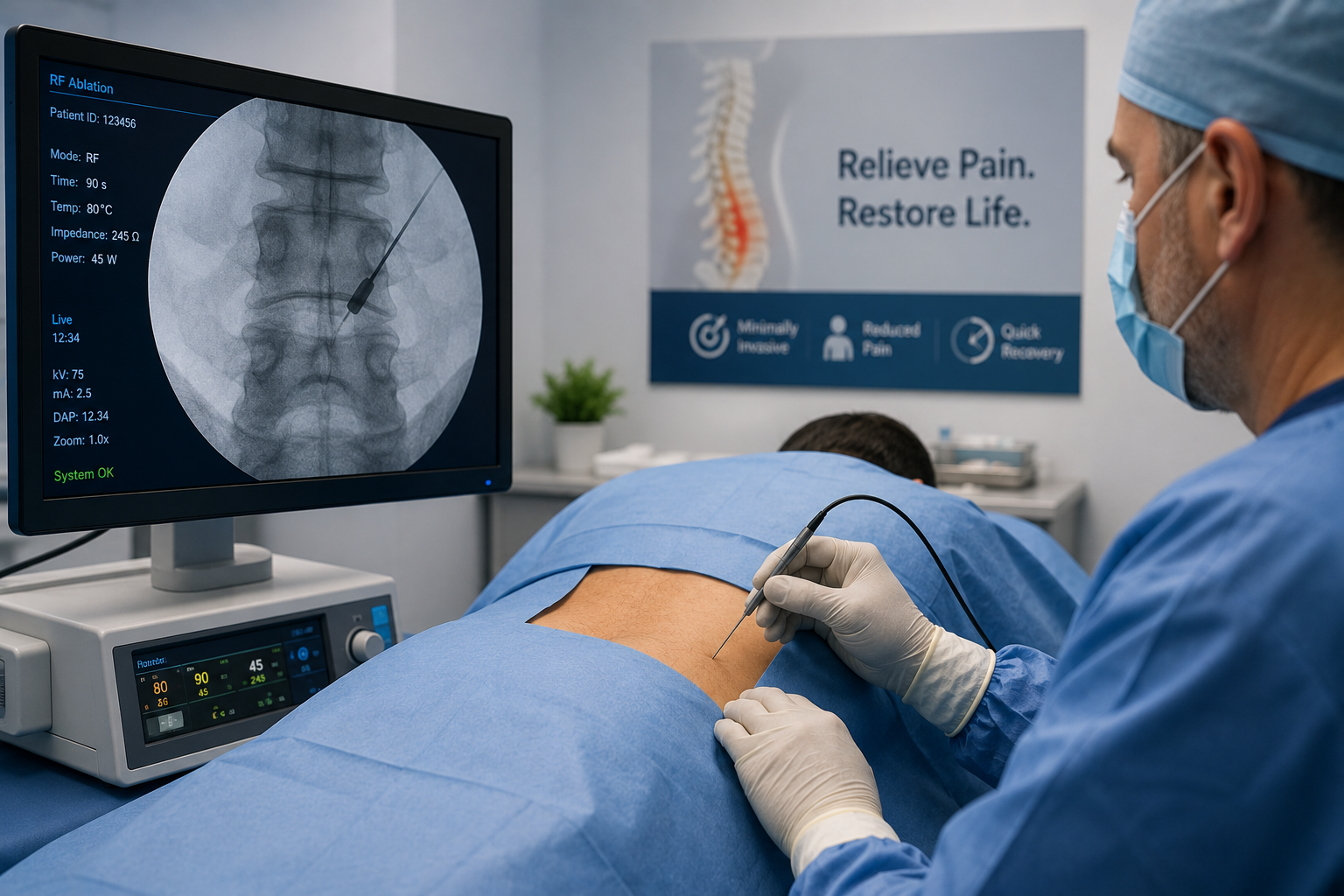
During RFA, the doctor uses imaging guidance to position a specialized needle or electrode near the targeted nerve.
Radiofrequency energy is then delivered through the electrode to create a controlled thermal lesion around the targeted nerve.
The procedure is designed to affect the targeted sensory nerve while avoiding unnecessary injury to surrounding structures.
What Conditions Can Radiofrequency Ablation Help?
RFA is commonly considered for certain types of chronic spinal and joint-related pain.
1. Facet Joint Pain
Facet joints are small joints located at the back of the spine. Changes in these joints can contribute to chronic neck or back pain in some patients.
When diagnostic evaluation indicates that facet joint nerves are contributing to pain, RFA may be considered.
2. Sacroiliac Joint-Related Pain
The sacroiliac joints connect the lower spine to the pelvis.
Some patients experience chronic pain originating from this region. Depending on the source of pain and diagnostic findings, nerve-targeted procedures may form part of a broader treatment plan.
3. Certain Chronic Joint Pain
Radiofrequency techniques may also be used for selected patients with chronic pain involving certain joints.
The exact approach depends on the joint, the nerves involved, the underlying condition, and the patient’s overall health.
Who May Be a Candidate for Radiofrequency Ablation?
RFA is generally not the first treatment considered for every patient with back or joint pain.
A doctor may consider it when:
- Pain has persisted despite conservative treatment.
- The suspected pain source has been identified.
- Other treatments have not provided sufficient relief.
- Diagnostic nerve blocks support the suspected pain source.
- The patient’s symptoms and medical history are appropriate for the procedure.
Your doctor will also consider other factors before recommending RFA.
What Happens During the Procedure?
1. Before Treatment
Your doctor will review your symptoms, medical history, medications, previous treatments, and relevant imaging.
You may receive specific instructions regarding medications, eating, drinking, and transportation depending on the type of procedure and sedation used.
2. During Treatment
RFA is typically performed using imaging guidance so the doctor can accurately position the treatment device.
The skin is cleaned, and local anaesthetic is used to numb the treatment area. A needle or electrode is then guided towards the targeted nerve.
Radiofrequency energy is applied for a controlled period.
The procedure itself is often relatively short, although the total time at the clinic can be longer because of preparation and monitoring.
3. After Treatment
You will usually be monitored for a period after the procedure.
Your doctor will provide instructions about activity, medications, wound care, and when you can return to normal activities.
The recovery experience varies between patients.
Does Radiofrequency Ablation Hurt?
Patients can experience pressure, discomfort, or a brief sensation during the procedure.
Local anaesthetic is typically used to reduce discomfort around the treatment area. Some patients may also experience temporary soreness after the procedure.
Your medical team can explain what you are likely to feel and what options are available to keep you comfortable.
How Long Does It Take to Work?
Pain relief does not necessarily occur immediately.
Some patients notice improvement relatively soon, while others may take several days or longer to experience the full benefit.
Temporary soreness can occur after the procedure, so the first few days do not necessarily reflect the final outcome.
Your doctor can give you more specific guidance based on the nerves being treated and your individual circumstances.
How Long Does Radiofrequency Ablation Last?
The duration of pain relief varies.
Because the targeted nerve can recover over time, RFA is not generally considered a permanent cure. Some patients experience relief for months or longer, while others may have a shorter response.
The underlying cause of pain also matters.
RFA does not necessarily stop the condition responsible for the pain from progressing. Instead, it aims to reduce pain signals from a specific nerve.
What Are the Potential Benefits of RFA?
It Can Reduce Chronic Pain
For appropriately selected patients, RFA may provide meaningful reduction in certain types of chronic pain.
It Is Minimally Invasive
Compared with major surgery, RFA generally involves a small needle-based treatment rather than a large incision.
It May Support Greater Mobility
When pain is reduced, some patients may find it easier to participate in physical therapy, exercise, or everyday activities.
It May Reduce Reliance on Some Pain Treatments
Depending on the individual situation, successful pain relief may reduce the need for certain other pain-management approaches.
This should always be discussed with your treating doctor rather than changing medication independently.
Are There Risks or Side Effects?
As with any medical procedure, RFA carries potential risks.
Temporary soreness, bruising, numbness, or discomfort around the treatment area can occur.
More serious complications are uncommon but can occur, depending on the treatment location and individual circumstances.
Your doctor should explain the potential benefits, risks, alternatives, and expected outcomes before you decide whether to proceed.
What Is Recovery Like After RFA?
Recovery varies depending on the treatment area and individual patient.
Some people return to normal activities relatively quickly, while others may need a short period of reduced activity.
Your doctor may recommend avoiding certain strenuous activities for a period after the procedure.
Following the post-procedure instructions is important for a safe recovery.
Is Radiofrequency Ablation Better Than Surgery?
RFA and surgery are not interchangeable treatments.
RFA is a minimally invasive procedure intended to reduce pain signals from selected nerves. Surgery may be recommended when there is a structural problem that requires correction.
Whether either option is appropriate depends entirely on the underlying condition.
For some patients, RFA may provide a way to manage pain without undergoing major surgery. For others, it may not address the underlying problem and a different treatment may be necessary.
What If Radiofrequency Ablation Does Not Work?
Not every patient responds to RFA.
If pain relief is limited or does not last, your doctor can reassess the diagnosis and consider other treatment options.
The pain may originate from a different structure, multiple pain generators may be involved, or another condition may need attention.
Pain management is often about finding the right combination of treatments rather than relying on one procedure.
How Does RFA Fit Into a Broader Pain Management Plan?
Radiofrequency ablation is usually only one part of a larger strategy.
Depending on the cause of pain, your treatment plan may also involve physical therapy, exercise, medication management, lifestyle changes, injections, behavioural approaches, or other interventional treatments.
The aim is not simply to reduce pain temporarily. A comprehensive plan should also consider movement, function, sleep, daily activities, and quality of life.
Personalized Pain Management for Back and Joint Pain
Living with persistent back or joint pain can make even ordinary activities feel difficult. Radiofrequency ablation offers a minimally invasive option for some patients whose pain is linked to specific nerves and who have not achieved sufficient relief from other approaches.
However, RFA is not appropriate for every type of pain. Careful diagnosis and patient selection are essential.
A consultation with an experienced pain management doctor can help determine whether the suspected pain source is suitable for RFA and whether another treatment may be more appropriate.
At Interventional Pain and Spine, we focus on understanding the source and impact of persistent pain before recommending treatment.
Our personalized approach can help patients understand their options, including interventional procedures such as radiofrequency ablation when clinically appropriate.
If chronic back or joint pain is affecting your daily life and conservative treatments have not provided enough relief, Interventional Pain and Spine can evaluate your condition and discuss appropriate pain management options.
Speak with our pain management doctor to explore a personalized approach to managing chronic pain.
FAQs
What is radiofrequency ablation used for?
Radiofrequency ablation is used to manage certain types of chronic pain by targeting nerves that transmit pain signals. It may be considered for selected patients with certain spinal, joint, or other nerve-related pain conditions.
Is radiofrequency ablation a permanent treatment?
No. The effect is not necessarily permanent because the targeted nerve can recover or regenerate over time. The duration of pain relief varies from person to person.
How do doctors know if RFA will help my pain?
Your doctor may use your medical history, physical examination, imaging, and diagnostic nerve blocks to determine whether a specific nerve is contributing to your pain and whether RFA may be appropriate.
Is radiofrequency ablation painful?
You may experience pressure or temporary discomfort during the procedure. Local anaesthetic is generally used around the treatment area. Some soreness may occur afterwards.
How quickly does RFA provide pain relief?
The timeline varies. Some patients experience improvement relatively soon, while others may take several days or longer. Temporary post-procedure soreness can occur before improvement becomes noticeable.
How long does radiofrequency ablation pain relief last?
The duration varies between patients and depends on factors such as the underlying condition and the nerves treated. Some patients experience relief for months or longer.
Can RFA treat lower back pain?
It can be considered for certain types of lower back pain, particularly when the pain is associated with specific structures such as the facet joints and the relevant nerves have been identified as pain generators.
Can radiofrequency ablation treat joint pain?
RFA may be appropriate for selected types of chronic joint pain. Whether it is suitable depends on the joint involved, the source of pain, your medical history, and the findings of your evaluation.
Is radiofrequency ablation safer than surgery?
RFA and surgery have different purposes and risks, so they cannot simply be ranked as safer or better. RFA is minimally invasive and may be an option for selected pain conditions that do not require surgical correction.
Who should I see to find out if RFA is right for me?
A qualified pain management doctor can assess your symptoms, medical history, previous treatments, and suspected pain source to determine whether radiofrequency ablation or another treatment may be appropriate.