When pain becomes part of your everyday routine, finding the right doctor can feel almost as frustrating as dealing with the pain itself.
You know something is wrong, but should you visit an orthopaedic specialist or a pain management doctor?
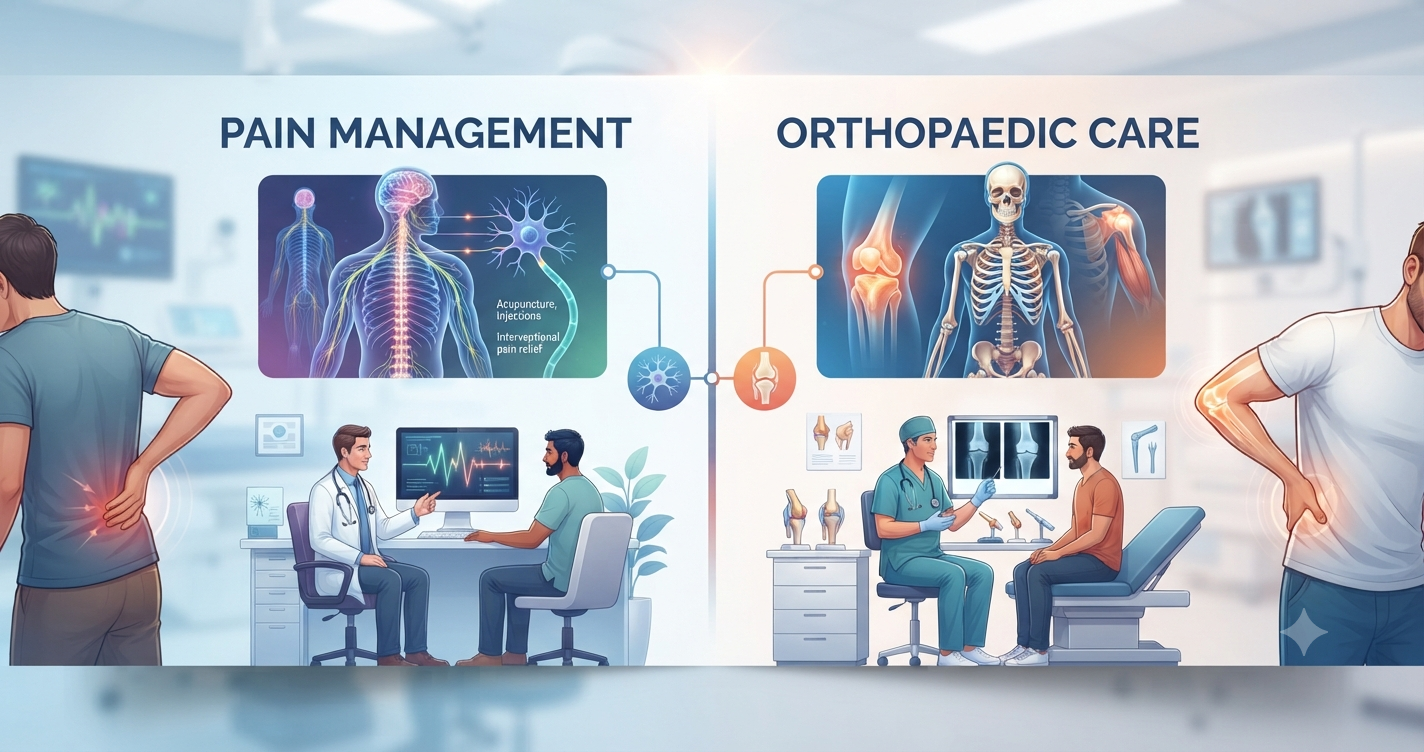
The difference between pain management and orthopaedic care comes down to what needs attention: the underlying musculoskeletal problem, the pain itself, or both.
Orthopaedic specialists focus on diagnosing and treating conditions affecting bones, joints, muscles, ligaments and tendons.
Pain management specialists focus on evaluating persistent pain and using medication-based, interventional and other nonsurgical approaches to help manage symptoms and improve daily function.
For many people living with chronic pain, these specialties can complement each other.
Understanding what each specialist does can help you choose an appropriate starting point for pain management in Arlington and avoid spending months exploring treatments that may not address your particular condition.
Understanding the Difference Between Pain Management and Orthopaedic Care
Although pain management and orthopaedic care sometimes overlap, they serve different purposes within musculoskeletal healthcare.
An orthopaedic specialist typically evaluates the physical structures responsible for movement and support.
A pain management specialist evaluates the source of discomfort and explores ways to reduce pain, improve function and support a patient’s quality of life.
Here is how their roles differ.
What Does an Orthopaedic Specialist Treat?
Orthopaedic specialists diagnose and treat conditions affecting the musculoskeletal system. This includes the bones, joints, cartilage, muscles, tendons and ligaments.
Common conditions treated by orthopaedic specialists include:
- Osteoarthritis and other joint conditions.
- Sports injuries.
- Fractures and bone injuries.
- Torn ligaments and tendons.
- Rotator cuff injuries.
- Meniscus tears.
- Hip and knee joint problems.
- Certain spinal conditions and structural abnormalities.
Depending on the condition, treatment may involve physical therapy, medications, bracing, injections or surgery.
For example, someone with a significant knee ligament tear may need an orthopaedic evaluation to determine the extent of the injury and whether surgical repair is appropriate.
What Does a Pain Management Specialist Do?
Pain management specialists focus on identifying potential pain generators and developing treatment plans to address persistent or difficult-to-manage symptoms.
They commonly evaluate pain involving the spine, joints, muscles and nerves.
Conditions they may help manage include:
- Chronic lower back pain.
- Neck pain.
- Sciatica and nerve-related pain.
- Herniated disc-related symptoms.
- Spinal stenosis.
- Facet joint pain.
- Certain types of arthritis-related pain.
- Persistent pain following an injury or surgery.
Treatment may include medication management, targeted injections, radiofrequency ablation and other interventional procedures.
The objective is to address the factors contributing to pain while helping patients maintain or improve their everyday activities.
When Should You See a Pain Management Specialist?
If pain continues for weeks or months, repeatedly returns or interferes with your daily activities, a pain management evaluation may be worth considering.
Chronic pain is generally defined as pain lasting longer than three months or persisting beyond the expected period of healing. However, you do not need to wait three months to seek medical attention for concerning or worsening symptoms.
1. Your Back Pain Keeps Returning
Lower back pain can develop from several conditions, including degenerative disc changes, herniated discs, spinal stenosis and facet joint problems.
If discomfort continues despite rest, activity modification or other conservative treatments, a pain management specialist can evaluate whether a targeted treatment approach may be appropriate.
2. Pain Travels Into Your Arms or Legs
Pain that radiates from the spine into an arm or leg may involve irritation or compression of a nerve.
You might experience:
- Burning or shooting sensations.
- Tingling or pins-and-needles feelings.
- Numbness.
- Pain extending from the lower back into the buttock or leg.
- Discomfort extending from the neck into the shoulder or arm.
A pain management specialist can evaluate these symptoms and determine whether nerve-related treatments, including certain spinal injections, should be considered.
3. Medication Is Not Providing Enough Relief
Taking medication may help manage discomfort, but persistent pain sometimes requires a broader treatment strategy.
A pain management specialist can review your current medications, medical history and previous treatments to determine whether adjustments or other approaches may be appropriate.
Patients should never discontinue prescribed medications without consulting their healthcare provider.
4. You Want to Explore Nonsurgical Treatment Options
Not every painful spinal or joint condition requires surgery. Depending on the diagnosis, several nonsurgical treatments may be available.
These may include targeted injections, radiofrequency ablation, spinal cord stimulation and other interventional pain management approaches.
The suitability of each procedure depends on the underlying condition and an individual’s overall health.
When Is Orthopaedic Care the Better Starting Point?
Pain management is not a replacement for orthopaedic evaluation when a problem involves significant structural damage, an acute injury or a condition that may require surgical treatment.
An orthopaedic specialist may be the appropriate starting point when you experience:
- A recent injury: A fall, accident or sports injury that may have caused a fracture, ligament tear or joint damage.
- Persistent joint instability: A knee, shoulder or ankle that repeatedly gives way or feels unstable.
- Severe joint stiffness: Difficulty moving a joint, particularly when accompanied by swelling or restricted movement.
- Suspected structural damage: Symptoms suggesting a torn tendon, damaged cartilage or another musculoskeletal injury.
- Possible need for surgery: When imaging or clinical findings suggest that surgical intervention may be necessary.
Orthopaedic evaluation can help determine whether the problem requires structural repair, rehabilitation or another treatment approach.
Pain Management vs. Orthopaedic Care: A Side-by-Side Comparison
Still unsure which specialist to contact? This comparison can help clarify their different roles.
| Category | Pain Management | Orthopaedic Care |
| Primary focus | Evaluating and managing pain | Diagnosing and treating musculoskeletal conditions |
| Common conditions | Chronic back pain, nerve pain, sciatica | Fractures, joint injuries, ligament tears |
| Treatment options | Injections, medication management, RFA, spinal cord stimulation | Rehabilitation, medications, injections and surgery |
| Main objective | Manage pain and improve daily function | Restore or improve musculoskeletal structure and function |
| Surgery | Primarily focuses on nonsurgical pain treatments | May include surgical treatment when appropriate |
Neither specialty is automatically better than the other. The most appropriate specialist depends on the condition causing your symptoms and the type of treatment you may need.
Can You See Both a Pain Management Doctor and an Orthopaedic Specialist?
Yes. In fact, some patients benefit from care involving both specialties.
Consider someone experiencing chronic knee pain due to osteoarthritis. An orthopaedic specialist may evaluate the degree of joint damage and determine whether surgery should be considered.
A pain management specialist may explore appropriate nonsurgical options to help manage discomfort, depending on the patient’s symptoms and medical history.
A similar approach may apply to spinal conditions. An orthopaedic spine specialist may evaluate structural problems, while a pain management specialist may recommend targeted procedures to address certain sources of pain.
This collaborative approach can help patients understand their options and make more informed treatment decisions.
What Should You Expect During a Pain Management Consultation in Arlington?
Your first appointment should be about understanding your pain, not immediately choosing a procedure.
A pain management specialist typically reviews several factors before recommending treatment.
- Medical History: Your doctor will ask when the pain started, how frequently it occurs and whether anything makes it better or worse.
- Physical Examination: This may include evaluating movement, flexibility, strength, sensation and areas of tenderness.
- Diagnostic Review: Existing X-rays, MRI scans or other imaging may be reviewed when relevant. Additional testing may be recommended if necessary.
- Treatment Discussion: Your specialist will explain appropriate options, including their potential benefits, limitations and risks.
- Personalized Treatment Planning: Recommendations will reflect your diagnosis, health history, previous treatment response and individual goals.
This process helps ensure that treatment decisions are based on more than symptoms alone.
Frequently Asked Questions
1. Is a pain management doctor the same as an orthopaedic doctor?
No. Orthopaedic specialists primarily diagnose and treat musculoskeletal conditions, while pain management specialists focus on evaluating and managing pain through medication, procedures and other treatment strategies.
2. Should I see a pain management doctor for chronic back pain?
A pain management consultation may be appropriate if back pain persists, repeatedly returns or interferes with daily activities. The specialist can evaluate potential causes and discuss suitable treatment options.
3. Can a pain management specialist help with arthritis?
Yes. Pain management specialists may help manage certain types of arthritis-related pain through medication management, joint injections and other appropriate interventions. Treatment depends on the affected joint and severity of the condition.
4. Do pain management doctors perform surgery?
Interventional pain management specialists primarily provide nonsurgical treatments. These may include spinal injections, radiofrequency ablation and spinal cord stimulation procedures.
5. When should I seek immediate medical attention for pain?
Seek emergency medical attention for severe or rapidly worsening symptoms, particularly new bladder or bowel control problems, saddle-area numbness or progressive weakness. These may indicate a serious neurological condition.
6. Can I receive pain management treatment without surgery?
Yes. Many pain management treatments are nonsurgical. However, whether these options are appropriate depends on the underlying diagnosis, symptoms and individual medical circumstances.
Find the Right Pain Management Approach in Arlington, TX
Chronic pain can gradually change the way you work, move, sleep and enjoy everyday life.
The frustration often comes from not knowing where to turn next or whether you are addressing the actual source of your discomfort.
Choosing between pain management and orthopaedic care does not have to be confusing.
The important first step is finding a specialist who understands your symptoms, evaluates the underlying condition and helps you explore appropriate treatment options.
At Interventional Pain and Spine, we provide patient-centred interventional pain management focused on understanding individual needs and developing personalized treatment plans.
Our board-certified specialists offer treatment options that include spinal injections, joint injections, radiofrequency ablation, spinal cord stimulation, Vertiflex, Botox and StemWave therapy.
We understand that every patient’s experience with pain is different. That is why we focus on careful evaluation, clear communication and treatment recommendations based on each patient’s diagnosis, medical history and goals.
If chronic back pain, neck pain, joint discomfort or nerve-related symptoms are affecting your quality of life, contact Interventional Pain and Spine to schedule a consultation for pain management in Arlington.
Our team can help you understand your pain management options and determine whether interventional treatment may be appropriate.
You deserve a treatment plan that looks beyond where it hurts and considers what may be causing the pain in the first place.